
Air Conditioners: Is it actually more efficient to run your AC all day?
Wirecutter recently recirculated their article, “It’s Actually Okay to Run the AC All Day (Even If You’re Not Home)”, and we at Kelvin want to show that not only is that not true, but the picture is more complicated than what is painted in their article.
The Wirecutter Experiment:
The Wirecutter article tested two of the same window AC units and a single zone mini-split heat pump.
The two window ACs went in two different apartments in the same building, but on different floors. Additionally, they faced different directions and different floors.
The mini-split heat pump went in a different building, but in an apartment of a similar size as one of the window AC tested apartments.
The test ran across two days, each day reaching peak temperatures above 93 degrees fahrenheit.
For the first day, they tested energy usage when units were turned off from noon until 5pm (peak heat hours), and recorded how long and how much energy it took to reduce the indoor temperature back to 72 degrees.
The following day, they left the units running all day, set at 72 degrees.
Using a plug-in energy monitor, they found that all three apartments used more energy when the AC was turned off intermittently than when it was left running all day.
Kelvin Analysis:
While the team at Wirecutter was on the right track, their short run experiment failed to address some of the most important variables when it comes to heating and cooling. Such variables include: time of use, building weatherization and envelope, and building’s heat storage capability.
Here’s why these variables matter:
Time of use: AC units are generally less effective in extreme heat. This means that if you blast AC during the hottest parts of the day, the AC may end up using more energy than during a cooler part of the day.
Heat storage: Without any cooling mechanisms, heat flows into a building when the outdoor temperature is higher than the indoor temperature. If there is a lot of accumulated heat inside the building, the AC or heat pump will have to use more energy to reduce the indoor temperature. For example, leaving the AC off overnight for 8 hours and then turning it on to cool the space will use less energy than leaving the AC off for 8 hours during the daytime and then turning it on to cool the space.
Building weatherization and envelope: If a space is not well insulated and optimized for energy efficiency, the amount of energy you use to cool the space will be much greater than if you try to cool a space that is well insulated and optimized.
A team of architectural and building systems engineers ran a similar experiment using central AC, an air source heat pump (ASHP), and a mini-split, but took the Wirecutter experiment one step further by testing the appliances in two different climates- the dry heat in Arizona and the humid heat in Georgia. The team used National Renewable Energy Laboratory’s energy modeling software to analyze energy use in this experiment.
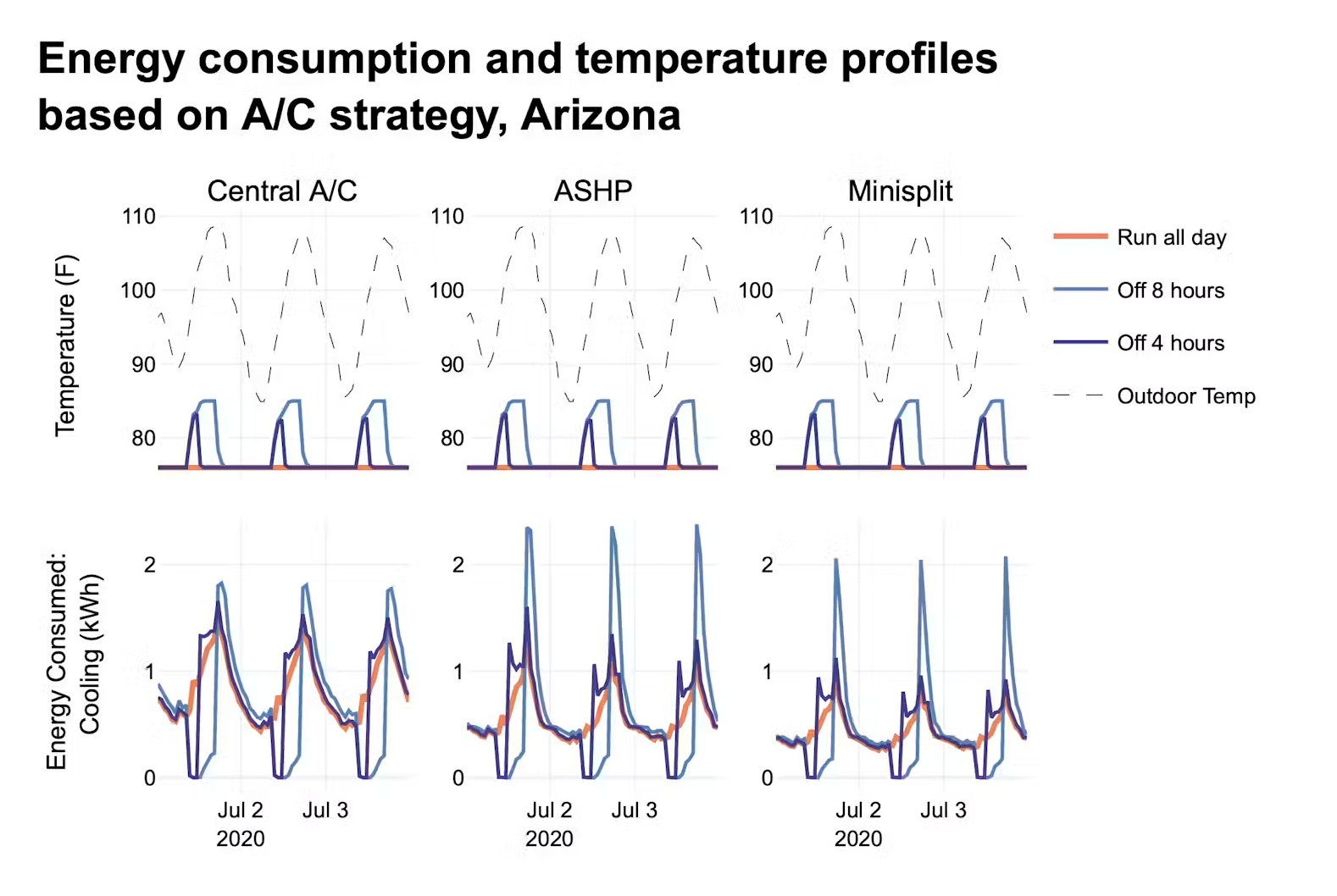
Image by Pigott/Scheib/Baker/CU Boulder, CC BY-ND
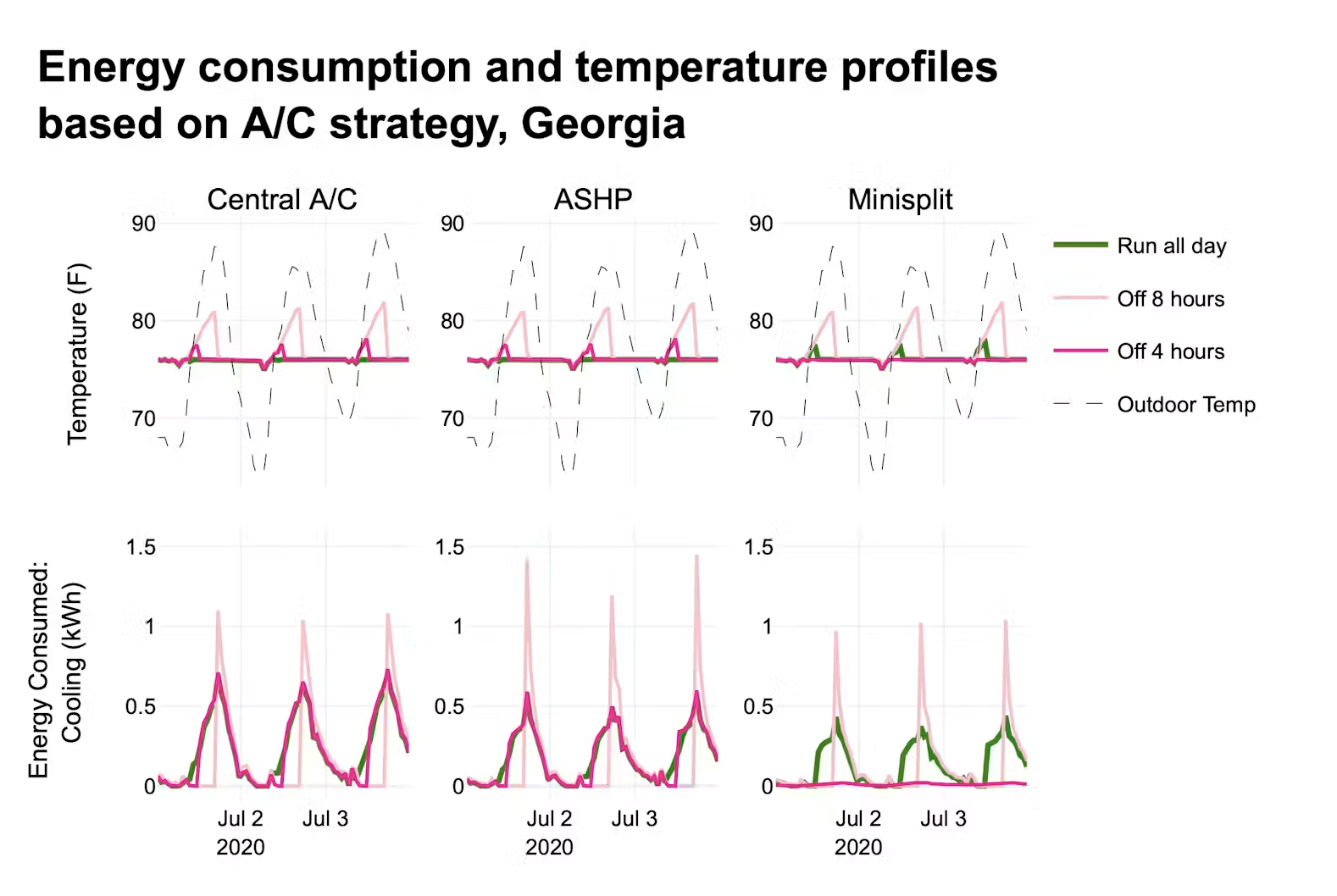
Image by Pigott/Scheib/Baker/CU Boulder, CC BY-ND
In addition to the two day experiment, the team ran a simulation to see what the outcome would look like over the course of a year. Here are their findings:
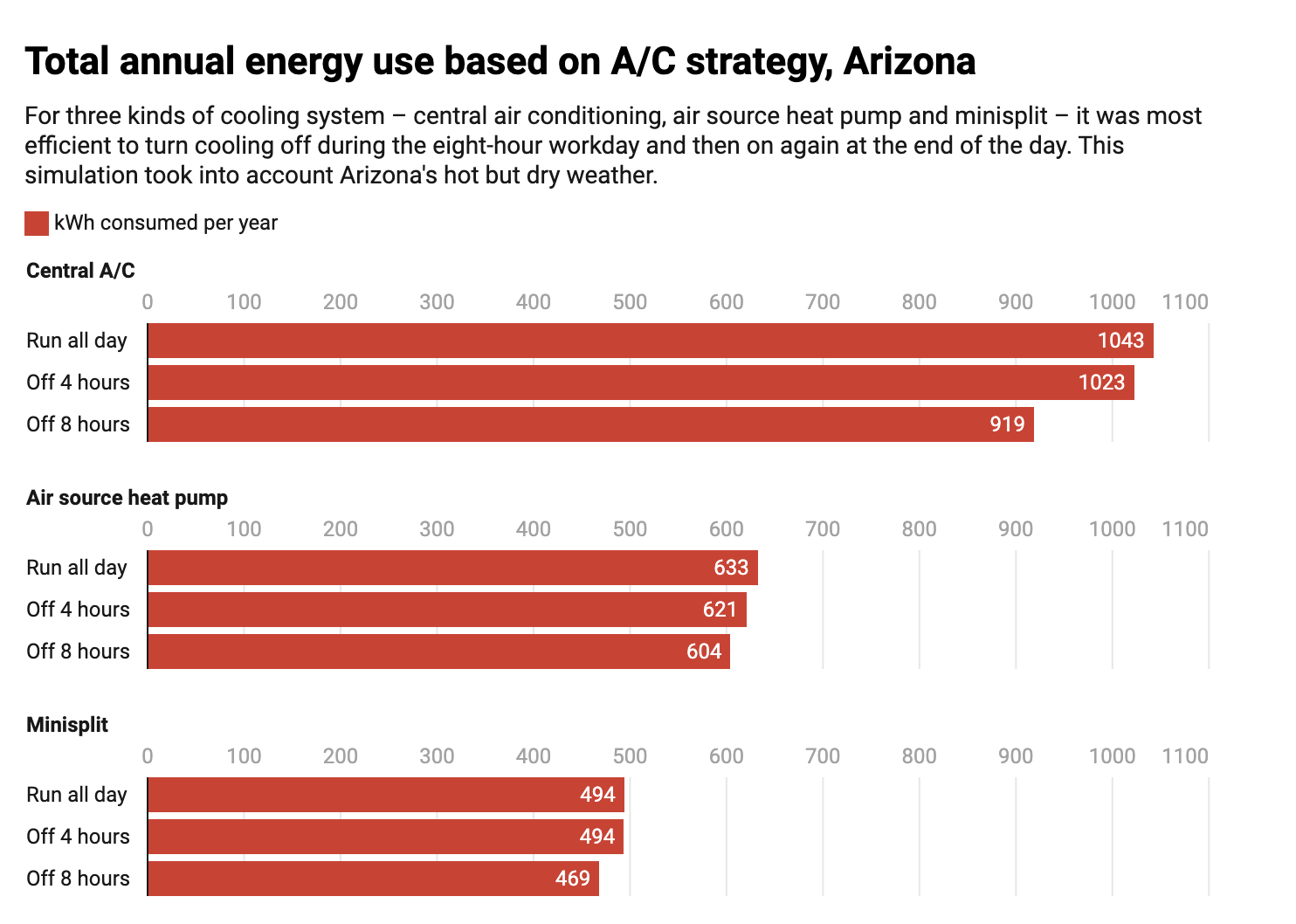
Chart: The Conversation, CC-BY-ND Source: Pigott, Scheib, Baker/CU Boulder
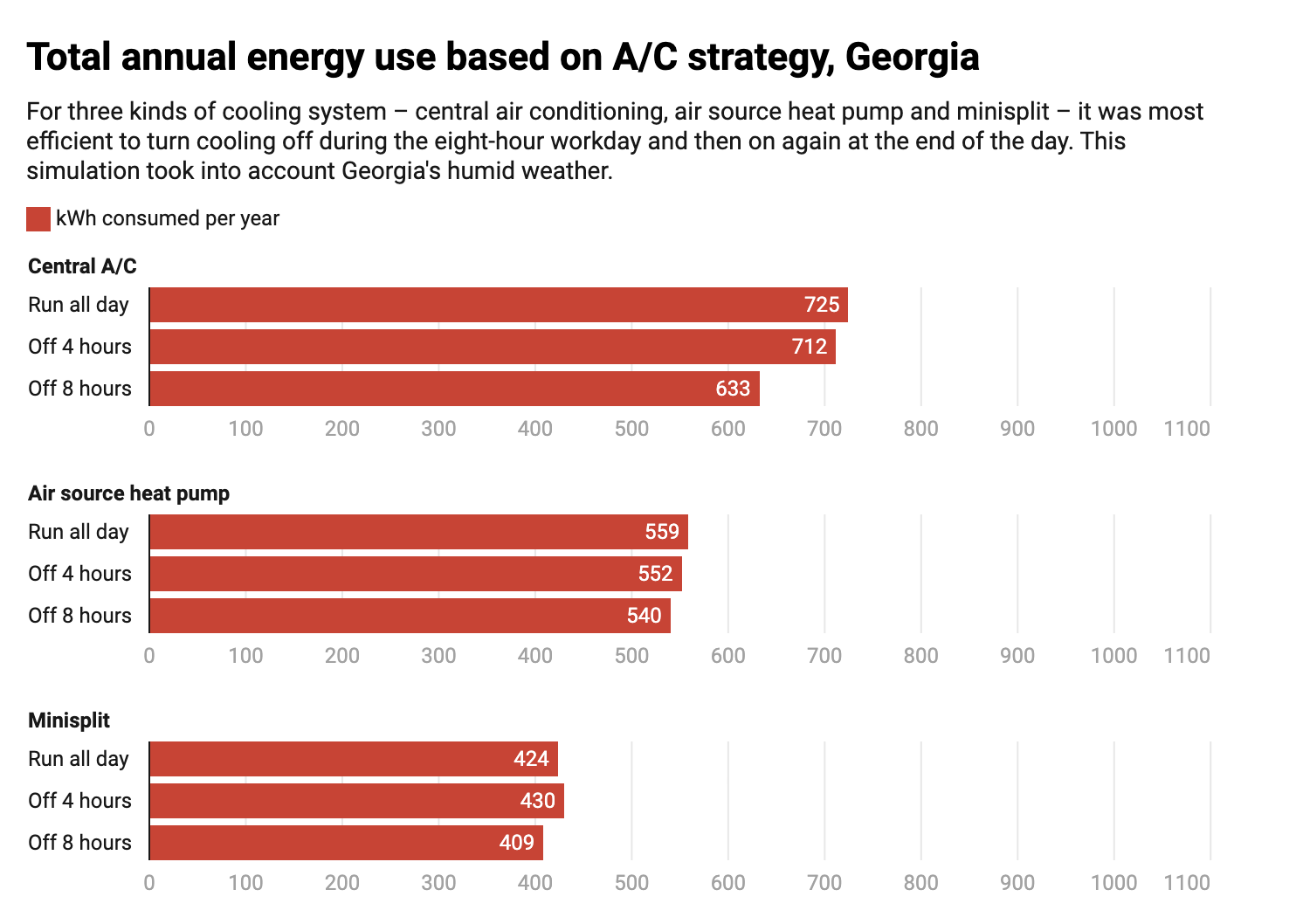
Chart: The Conversation, CC-BY-ND Source: Pigott, Scheib, Baker/CU Boulder
In conclusion, energy usage is highly variable depending on the building, but in nearly every single scenario studied in the experiment, the engineers found that it is not more efficient to run a cooling unit all day long.
The Kelvin Advantage
Figuring out the most efficient timing strategy can feel like more than what the average person is willing to do to save energy and stay comfortable. With Kelvin, you don’t have to worry about that.
Kelvin provides two distinct benefits:
Heat Pump Orchestration: Through software manipulation, Kelvin will schedule heat pumps to turn on and off at the most efficient heating and cooling times. This means that your heat pump will be using as little electricity as possible to heat and cool your space.
Demand Response Enrollment: When Kelvin orchestrates heat pumps building wide so that they operate during off-peak hours, this qualifies the building for their utility company’s demand response program. Kelvin will enroll the building to their program, enabling the building to create a new revenue stream through their coordinated heat pump usage.
Does this sound like something your building could benefit from? Shoot us an email at [email protected]